

Start small, one compact unit
The DC Compact with two charge points, on wall, pedestal or wheels. Ideal as a first step or for locations with short parking times.
Blulinc distributes Autel across Europe, exclusively to professional partners: wholesalers, installers, resellers and webshops.
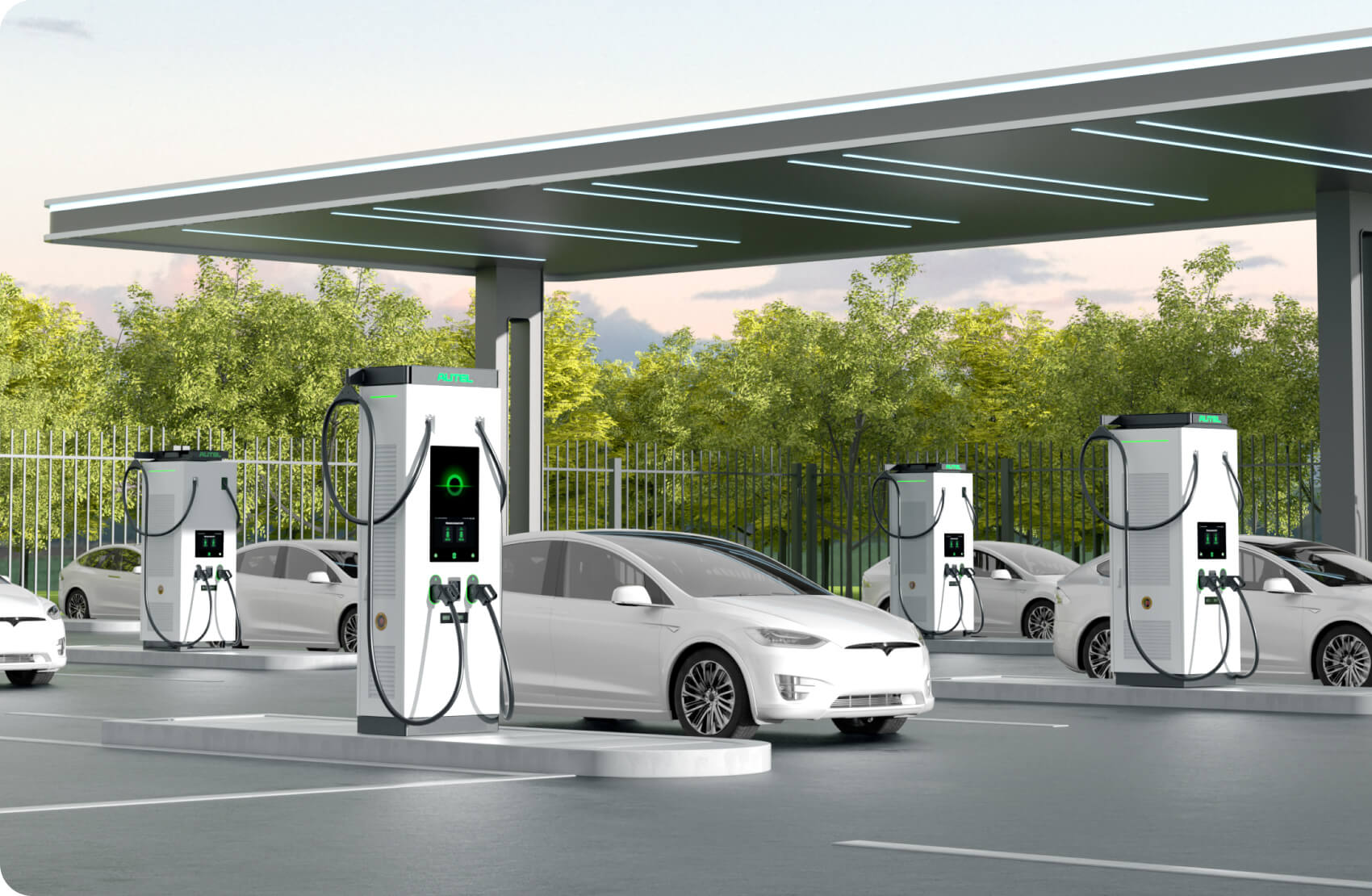
Building a charging plaza is more than placing chargers. This is the step-by-step plan we follow with installers and project developers, from the first site analysis to the handover of a working plaza.
 Laadplein
Each step builds on the previous one. Following the order avoids the two classic pitfalls: an undersized grid connection and cables that have to be laid again.
Who parks here, for how long and how often? Shop visitors charge differently from a bus depot. That analysis determines the power and the number of charge points.
You carry out the grid connection yourself, together with your engineering firm and the grid operator. We do not perform it, but we do advise: we check the required charging power against the available kVA and help dimension cables and protection. With a power cabinet and dispensers you distribute the power smartly, without an expensive upgrade.
A compact 50 kW for short stays, a cabinet with dispensers for a public plaza, or megawatt charging for trucks. We compose the configuration with payment terminals and options.
Environmental permit, foundations, cable ducts and passages. Cable sizing according to NEN 1010 or the AREI happens before the groundworks start.
The chargers are placed, connected and protected. With a cabinet and dispensers we align distances and cooling with the setup.
We configure every unit on your OCPP platform, test every charging session and hand over with a report. Optionally the plaza is followed up via 24/7 monitoring.
The Autel DC range covers every phase of a plaza, from the first two charge points to a hub that grows with you.
The DC Compact with two charge points, on wall, pedestal or wheels. Ideal as a first step or for locations with short parking times.
One cabinet with two to four charge points and an integrated payment terminal. Suitable for cars and vans.
One power cabinet distributes the power across several dispensers. Expanding means adding a dispenser, not a new grid connection.
Megawatt charging for heavy transport, with CCS2 for trucks and MCS where available.
 Installatie
A public or semi-public plaza needs more than power. These three points determine daily operations.
Payter P66 or Apollo are integrated into the DC units. Visitors pay by card or phone, without an app or subscription.
For billing third parties we supply versions with MID certified metering, and for Germany versions that comply with Eichrecht.
Autel works on any charge platform via OCPP 1.6J and 2.0.1 where available. You choose the platform, Blulinc configures the units and monitors alongside via a proxy url.
On our fast charging guide you find the full breakdown from 50 kW to 1.4 MW, with the matching units and installation steps for each power class.
View the fast charging guide →Allow three to six months from first analysis to handover. The grid connection and the permit usually set the timeline, not the chargers themselves. We deliver AC units in 7 to 10 working days, DC in 8 to 12 weeks.
That follows from the number of vehicles and their dwell time. A retail car park with short stops manages with 50 to 160 kW, a public fast charging plaza needs 480 kW or more. With a power cabinet and dispensers you spread the available power across more charge points.
Yes, if you choose a power cabinet with dispensers. An extra charge point is then a dispenser added to the existing cabinet. That is why we always size the cabinet for the final layout, not the first phase.
Blulinc configures every unit on the customer's OCPP platform and hands over with a test report. Afterwards the plaza can be followed via 24/7 monitoring, so faults are resolved quickly.
Every cost item, from the charger to handover, with three typical projects. A page you can forward to your client.
View the costs →