Charging hub costs: what does it cost to install a fast charger?
This page lists every cost item of a charging hub, from the charger to handover. Installers are welcome to forward it to their client as the answer to the question of what a fast charger or charging hub costs.
Short answer
Installing a fast charger costs the charger itself plus the works around it. Hardware is the predictable part: an AC charge point starts at a few hundred euro, a DC 50 kW sits in the tens of thousands, and a power cabinet with dispensers for a full charging hub runs to several tens of thousands per cabinet. On top come the grid connection, civil and cable works, switchgear, inspection and yearly operation. For a charging hub the grid connection usually weighs heavier than the chargers.
Hardware: indicative price per kW class further down this page
Grid connection: driven by available kVA against requested power
Operation: follow up per charge point per year, separate from hardware
We do not publish invented figures here. Charger prices are on our price page, the rest of the budget depends on your site. Request an estimate and you receive a calculation based on your own connection, distances and number of charge points.
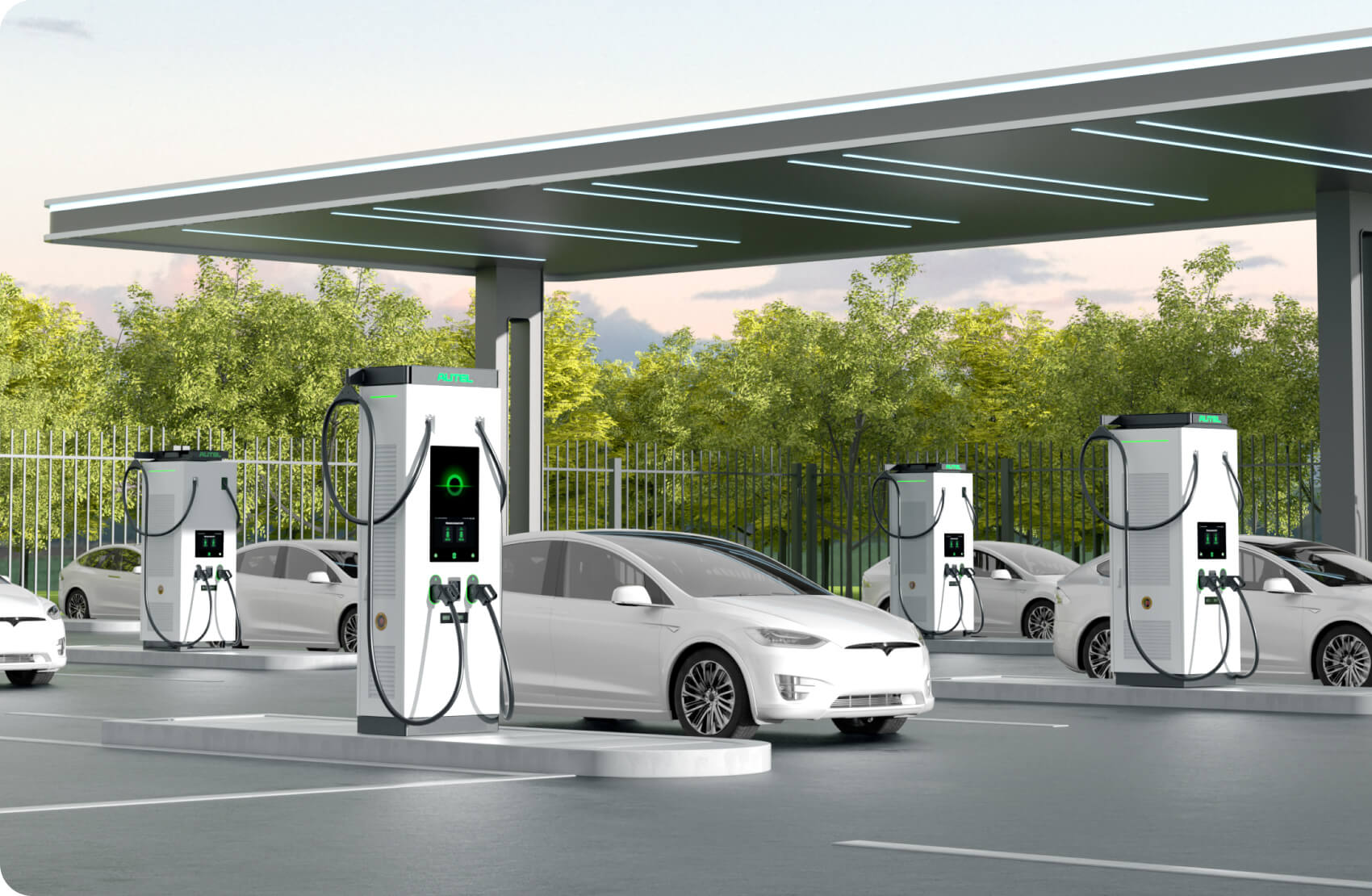
Laadplein
A plaza with multiple fast chargers: power sharing, throughput and payment drive the design.
Aansluiting
Installation to NEN 1010 and AREI: grid capacity, cable sizing and inspection agreed up front.
The seven cost items of a charging hub
Every project has the same cost items. What differs is their weight. For one client the grid connection dominates, for another the civil works do.
Power and number of charge points
The chargers
A compact 50 kW unit with two charge points costs a fraction of a power cabinet with dispensers. All list prices per model are public on our price page, partners see their own price there.
Payment, metering, cables
Options on the unit
Payment terminal (Payter P66 or Apollo), cable management, pedestal or wall mount, and versions with MID metering or Eichrecht compliance. Each option is shown with its price.
Available kVA versus requested power
Grid connection
The biggest unknown in any project. Does the existing connection suffice, or is an upgrade or a medium voltage substation required? That weighs on budget and lead time more than the chargers do.
Distance to the board
Civil works and cabling
Trenches, ducts, foundations, resurfacing and the cable cross-section for the distance. Twenty metres further is rarely twenty metres of extra cost, it is often an extra day of work.
Board work per charge point
Electrical material and protection
Breakers, earth leakage protection, metering and possibly a separate distribution board. With load balancing you put more charge points on the same connection and avoid an upgrade.
Once per installation
Inspection and handover
Inspection by an accredited body, a test report per charge point and the handover documentation for the owner. We supply the configuration report with it.
Per year, per connector
Configuration and operation
SIM card, connection to the charging platform and follow-up. Our 24/7 monitoring costs € 60 per year per AC connector and € 96 per year per DC connector. Configuration on your OCPP platform is done at delivery.
Hardware cost per power class
The first question is almost always: what does it cost to install a fast charger? That starts with the power class. Below is which units come into play per class, with their list price where one is set.
Office, apartment block, depot with long dwell time
AC up to 22 kW
The lightest item of all. An AC point is enough as soon as the vehicle stands still for more than three hours. Usually no civil works beyond the cable run, and no heavy grid request.
The entry level in fast charging. Wall, pedestal or mobile on wheels, with or without payment terminal. Often still fits an existing three-phase connection with load balancing.
Two to four charge points from one cabinet, air cooled or liquid cooled for intensive continuous use. Requires a heavy feed and usually a dedicated substation.
The cabinet spreads power across dispensers at the driveway. More expensive to start, much cheaper to extend: adding a charge point means placing a dispenser, not a new connection.
The DT300 charges trucks and buses over CCS2 from the ceiling, with no cables on the floor. The DT1500 does megawatt charging over MCS up to 1.2 MW. Both work with a power cabinet.
The list price per model and per option is public on our price page. After signing in, partners see their own price per level. All amounts exclude VAT, installation and inspection.
Grid connection cost: what sets the price
On a charging hub the grid connection is almost always the largest and slowest item. We do not publish figures we cannot stand behind, because they differ per grid operator and per street. This is what sets the price.
Available capacity
First measure what the existing connection still has spare. If the requested power stays below that, the most expensive item of the project disappears.
Upgrade or substation
A heavier connection is a case with the grid operator. Above roughly 250 kVA it usually means a dedicated medium voltage substation, with construction cost on top.
Lead time
Expect months, not weeks, for an upgrade or a new substation. This drives your planning more than the delivery time of the units.
Cable run and cross-section
The distance between board and charge point sets the cross-section. Allow at most 3 per cent voltage drop, with the breaker following from the cable, not the other way round.
Capacity tariff and peak
After installation the client pays on their monthly peak. With load balancing or a battery you keep that peak low, which lowers the operating cost year after year.
Metering and protection
Board work per charge point, earth leakage protection according to the manufacturer sheet and metering on the main connection for dynamic load balancing.
Three typical projects
To make the question concrete: these are the three set-ups we configure most often, with the matching units.
2 charge points, 50 kW
Retail or SME car park
One compact unit on the existing connection, with a payment terminal for visitors. Usually the lightest case: no substation, short cable run.
One cabinet with an integrated payment terminal. Here the grid connection comes into play: often an upgrade or a substation, plus works to the location.
A power cabinet distributing to dispensers. More expensive to start, cheaper to expand: adding a charge point means adding a dispenser, not a new connection.
The biggest saving rarely comes from a cheaper unit. It comes from the choices made before the civil works start.
Load balancing instead of an upgrade
Six charge points look like they need far more than your connection can deliver. With dynamic load balancing they share the available power safely, and you avoid the heaviest cost item of the project.
Cabinet and dispensers for growth
Size the cabinet for the end state, not for the first phase. Adding a dispenser is a day of work, a second grid connection is a case that takes months.
Ducts now, chargers later
During the first civil works, lay spare ducts to the next locations. Reopening the ground later almost always costs more than the ducts you lay today.
Forward your client's question
Asked what a charging hub costs, and you would rather not run the calculation yourself? Send us the question. We return the estimate to you, so you hand it to your client.
An installer in your client's region
Is the question from an end client without an installer? Forward the request and Blulinc will look for an installer in your client's region together with you.
Emailautel@blulinc.com
Phone+32 9 395 75 57
The price of the units
The list price per model is public on our price page, with article number and options. After signing in, partners see their own price per level.
The budget covers the units, the options, the grid connection, civil works and cabling, board work, inspection and annual follow-up. The units are the most predictable part: the list price per model is on our price page. The grid connection is the least predictable part and differs per grid operator and per site. Request an estimate and you receive a calculation on your own connection, distances and number of charge points.
What does it cost to install a fast charger on an existing car park?
If the existing connection has enough capacity, it stays limited to the unit, the cable run, the board work and inspection. A compact 50 kW is then the lightest case. If the connection needs upgrading, that upgrade immediately becomes the largest item, and we first check whether load balancing can avoid it.
What does it cost to install a fast charger?
The charger is only part of the budget. Besides the unit and its options, count the grid connection, civil works and cabling, board work, inspection and the yearly follow-up. With a compact unit on an existing connection it stays limited; for a hub with a new substation the connection becomes the largest item.
What is the most expensive item in a charging hub?
Almost always the grid connection. An upgrade or a medium voltage substation weighs more than the chargers themselves, and it also drives the schedule. That is why we first compare requested power against available kVA, and use load balancing wherever it avoids an upgrade.
Can I spread the budget over several phases?
Yes. Choose a power cabinet with dispensers and lay ducts to the next locations during the first works. The first phase costs slightly more, every following phase far less, because the connection and the trenches are not redone.
What does management cost per year?
Configuration on your OCPP platform is done at delivery, with no subscription with us. If you want us to watch along, our 24/7 monitoring costs € 60 per year per AC connector and € 96 per year per DC connector. What your platform charges depends on the provider you choose.
Building a charging plaza, from planning to delivery
Each step builds on the previous one. Following the order avoids the two classic pitfalls: an undersized grid connection and cables that have to be laid again.