

AC or DC for a company car park? A practical guide
Choose around the energy vehicles need during their parking time, not the highest rated power. Here is how to assess AC, DC or a combination for a company car park.
Updated:
Start with four inputs, not a charger
For each user group, record daily energy demand in kWh, available parking time, the number of vehicles that must charge simultaneously and spare grid connection capacity. Employees parked for a working day have a different charging profile from service vehicles returning between trips. This guide uses design examples, not a completed customer case.
AC: charging during a working day or overnight
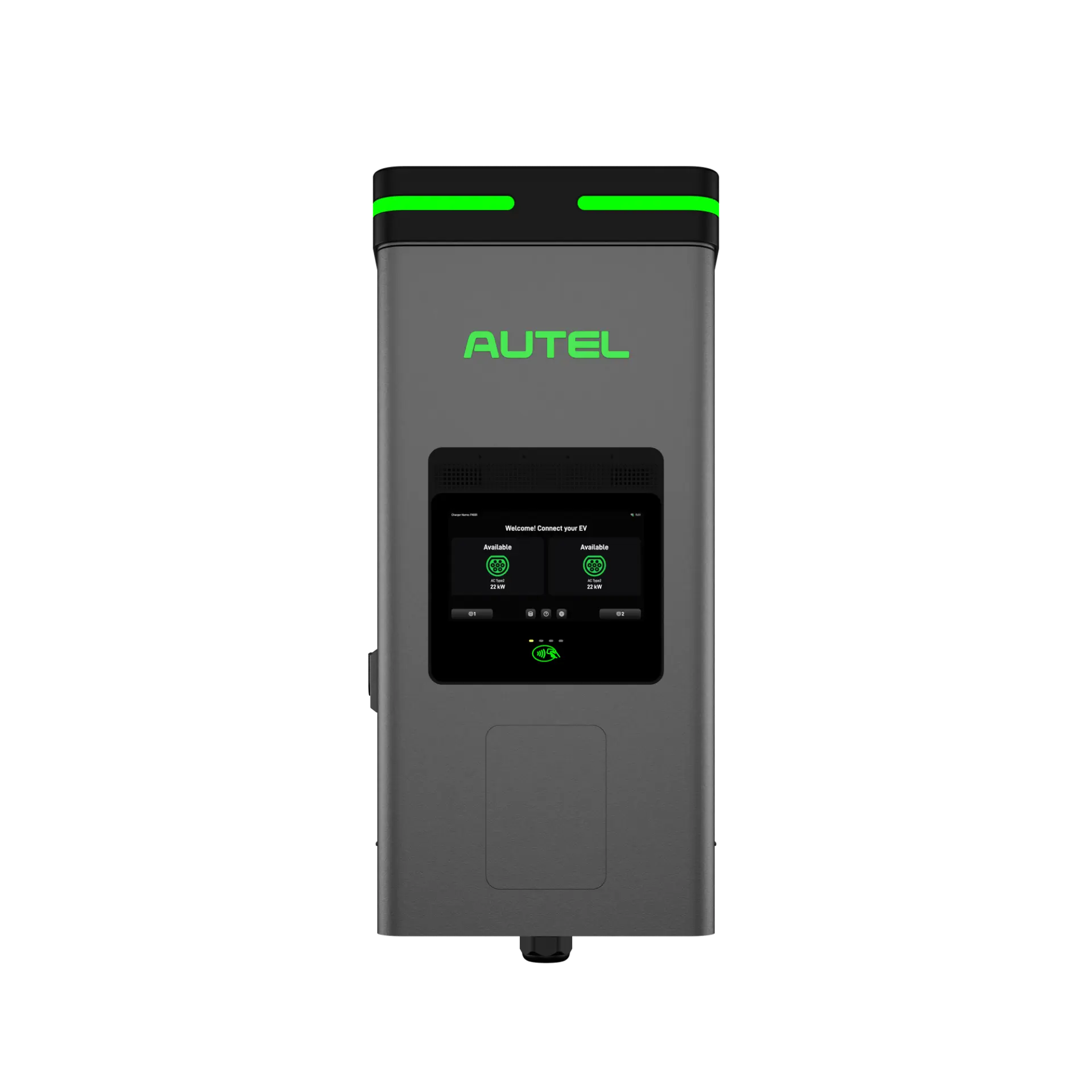
With AC charging, the vehicle’s onboard charger converts alternating current into direct current for the battery. AC is a logical first option when vehicles stay for several hours and their energy needs can be met in that time. The Autel Single Charger offers up to 22 kW; the Autel AC Ultra and Ultra Street have two charge points rated up to 22 kW each. Actual power also depends on the vehicle and installation.
Worked example: an employee needs 30 kWh
Suppose a car needs 30 kWh and stays for six hours. The theoretical average power requirement is 30 / 6 = 5 kW. At a constant 11 kW, the same energy transfer theoretically takes about 2 hours and 44 minutes. This simplified example excludes losses, power sharing and interruptions. A 22 kW charge point cannot charge faster than 11 kW if the vehicle’s AC onboard charger is limited to 11 kW.
DC: when the charging window is short
With DC charging, conversion takes place in the charger and direct current is supplied to the battery. A service vehicle needing 30 kWh during a 45-minute stop requires an average of 40 kW before losses. The Autel DC Compact 50 kW is a candidate for technical assessment. For larger energy requirements, the modular DH240 and DH480 are options, not an automatic default for an office car park. Check vehicle compatibility, its charging curve and power sharing.
Combine technologies for different users
One possible layout uses AC for employees with long parking times and a separate DC bay for vehicles that need to leave quickly. Determine quantities from actual occupancy, not a fixed AC/DC ratio. Agree on access, reservations and moving vehicles after charging.
Check building demand and peak load
Ten points each supplying 11 kW simultaneously require 110 kW of charging power. This theoretical simultaneous demand does not automatically mean the grid connection needs upgrading. Dynamic load management can limit charging according to building consumption, but does not create additional energy. The installer checks the connection, cables, protection, metering and local requirements. Also confirm that the required energy can be delivered within the available time.
Request a complete quote and keep platform choice open
Compare the power supply, cable routes, protection, any grid upgrade, management and maintenance as well as the charger. Autel supplies the hardware. Blulinc supports partners with distribution, documentation, training and optional configuration. Connection to the partner’s CPMS uses OCPP; agree on the version and functions beforehand. Preconfiguration is optional, not included as standard. Include the four initial inputs and the required platform connection in your quote request.
Sources and limits of this guidance
Technical principles: the public Electrify.brussels business guide, chapter 3 on charging modes, power and grid connections (accessed 18 October 2026). Autel model ratings come from the existing product sheets on this site. All calculations are illustrative scenarios. Actual charging times depend on the vehicle, battery temperature and state of charge, losses and available capacity, among other factors. Have the installer confirm the final sizing.